

In most cases, retinal detachment develops slowly.
The first symptom is often the sudden appearance of a large number of spots floating loosely in the eye. You may also notice a curious sensation of flashing lights.
The retina does not contain sensory nerves that relay the sensation of pain, therefore the condition is painless.
Detachment usually begins at the thin peripheral edge of the retina and extends gradually towards the more central areas. The patient perceives a shadow that begins peripherally and grows in size, slowly encroaching on the central vision.
As long as the centre of the retina is unaffected, the vision when the person is looking straight ahead is normal, but when the centre becomes affected, the eyesight is distorted, wavy and indistinct.
If the process of detachment is not halted, total blindness of the eye ultimately results. The condition does not spontaneously resolve itself.
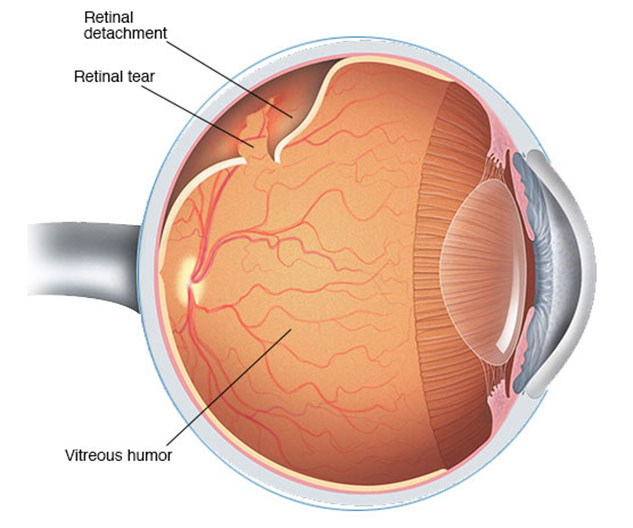
A rhegmatogenous retinal detachment occurs due to a hole or tear in the retina that allows fluid to pass through the hole and detaches the retina.
An exudative retinal detachment occurs due to inflammation, injury, tumour or vascular abnormalities that results in fluid accumulating underneath the retina without the presence of a hole, tear, or break.
A tractional retinal detachment occurs when scar tissue, caused by an injury, inflammation or diabetic retinopathy, pulls the sensory retina from the retinal pigment epithelium.