

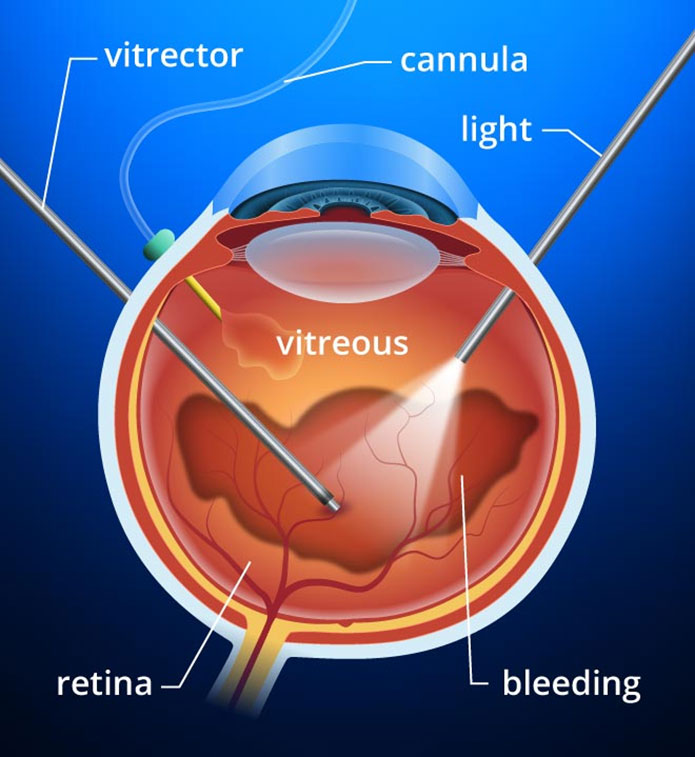
Vitrectomy refers to the removal of the vitreous gel that fills the cavity of the eye in order to get access to and treat conditions affecting the retina.
The procedure is used to treat a number of retinal conditions:
Vitrectomy is also sometimes used to treat conditions of the vitreous gel itself. These conditions can be a vitreous haemorrhage of severe vitreous opacities. This can reduce the amount of light that enters the eye, which in turn decreases vision.
Vitrectomy surgery is usually done under local anaesthetic and sedation. Three tiny incisions are made on the white of the eye, and a special surgical tool removes the vitreous fluid. Once the vitreous or retinal problem has been resolved, the eye is filled with silicon oil or gas.
After surgery, it may take some time to fully recover. It is usually necessary to wear an eye shield or patch for the first day after the procedure. Some patients may need to posture in a specific way for a number of days after the surgery- this instruction will be clearly given if it is expected.
Retinal detachment is a condition that occurs when the retina is pulled away from the underlying tissue and its nerve connections. This can be caused by a tear in the retina, traction or inflammation. This can cause permanent visual loss if left untreated.
Surgery is the only treatment option for retinal detachment. Surgery is either a vitrectomy where very small surgical instruments are placed through the wall of the eye to repair the retina from the inside. Sometimes, the retina can be repaired from the outside in a procedure called scleral buckling, where an external band is placed around the eye to support the retina.
The retina is reattached and the tear in the retina is treated with laser. A gas or silicone oil bubble is placed into the eye to help close the tear by pushing the retina and surrounding tissue together. If the retina is only torn but has not detached yet, the retinal tear can be treated with laser or cryopexy (freezing).
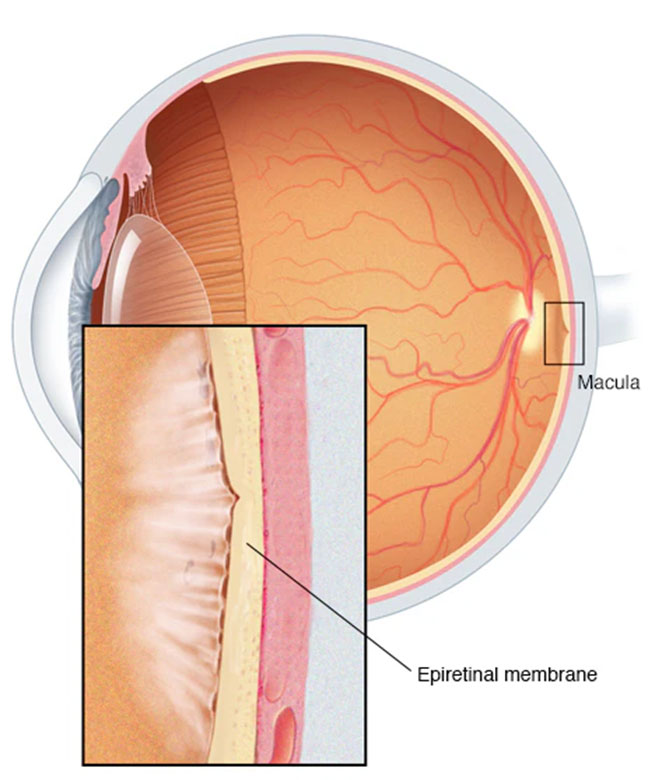
Epiretinal membrane refers to a wrinkled layer that develops on the surface of the macula. This is the area of the eye that is responsible for sharp, central vision. Epiretinal membranes develop for a number of reasons, including as a result of certain inflammatory diseases, or as a result of an injury affecting the eye. They can also occur in cases where there has been a retinal detachment in the past.
An epiretinal membrane causes blurred and distorted vision. The condition is be treated surgically with a vitrectomy. The vitreous gel is removed from the eye and the wrinkled membrane is peeled from the macula. The eye is then filled with gas or silicone oil.
Patients with diabetes may be affected by a group of conditions that fall into the category of diabetic eye disease. There are a number of problems that can occur, some of the most common diabetic eye problems include glaucoma, cataracts, diabetic retinopathy and diabetic macular oedema. The best treatment for these conditions will depend on the nature and severity of the symptoms.
It is important to note that early detection of these conditions goes a long way in reducing the risk of severe visual loss, and regular follow-up consultations are highly recommended. Patients with advanced diabetic eye disease may require laser treatment, intraocular injections, or surgery. Surgery is needed for proliferative diabetic retinopathy or vitreous haemorrhage. Diabetic retinopathy is scarring that forms on the surface of the retina and causes traction. Vitrectomy can be performed to remove this scarring and traction. The eye is then filled with gas or silicone oil.
Macular holes mostly occur spontaneously, but can be caused by trauma or other eye diseases. Treatment for a macular hole is vitrectomy, a procedure in which the ophthalmologist removes the vitreous gel. Once the vitreous fluid has been removed, a specially formulated gas is placed into the eye. The surface tension helps the macular hole to close over time.