

Age Related Macular Degeneration (AMD) is a progressive eye condition in which the nerve cells of the macula are damaged.
The macula is the part of the retina responsible for central vision. AMD can make it difficult or impossible to read or recognize faces.
Your peripheral vision remains unaffected to allow other activities of daily life. The inner layer, light sensitive nerve layer of the eye is called the retina. It functions like the film in a camera. If the film is damaged it will not record the image photographed by the eye.
The causes of AMD are not completely understood. The most common identified risk factors that may play a role are:
AMD is more likely to be found in Caucasians over the age of 55.
Symptoms
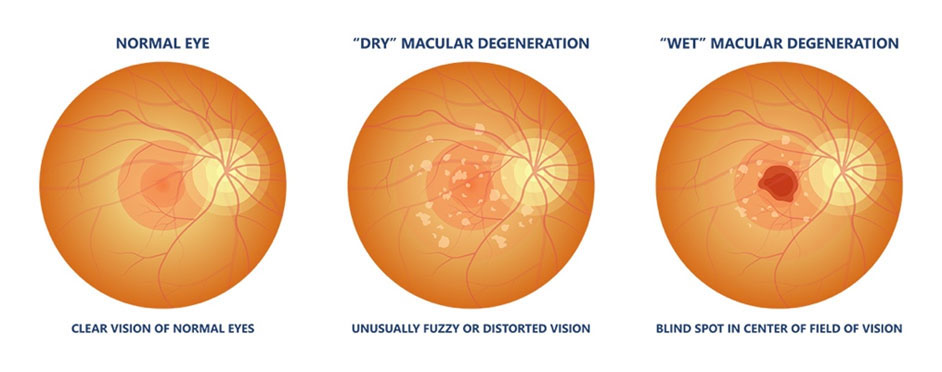
In dry AMD the nerve receptor cells of the macula degenerate. This is the most common form of macular degeneration. The degeneration is limited to the macular area and thus affects the central vision. The disease is slowly progressive. The rate of progress may vary. The condition eventually stabilizes.
Wet AMD is much less common. It occurs when abnormal blood vessels develop under the retina and leak fluid or bleed under the retina.
There are other macular diseases and degenerations that rarely occur in younger patients. Some of these conditions are genetic, while others can be due to infection and inflammation or underlying conditions such as diabetes.
There is as yet no outright cure for AMD, but some treatments may delay its progression or even improve vision.
The treatment for AMD depends on whether the disease is in its early stage, dry form or in the more advanced, wet form.
There is currently no proven treatment for dry AMD. In some people specific vitamin supplements containing lutein, zeaxanthin and certain trace elements such as zinc or selenium, may slow the progress of the disease.
The treatment for wet macular degeneration is aimed at stopping abnormal blood vessel growth. The treatment is injection of anti-vegf (vascular endothelial growth factor) to shrink leaky blood vessels and inhibit their growth.
In certain cases, a special laser can be used to treat these blood vessels.
People who have a family history of macular degeneration or who experience any vision problems should have regular eye exams after the age of 45. This will enable early diagnosis of the disease and make the few treatments that are available effective.
Macular degeneration cannot be prevented but the onset or progression may be delayed by: